Cold Email Templates for Startups: Pitching to Investors vs. Clients
The cost of securing an opportunity through outreach has increased by 500% over the last five years.
With inboxes more crowded than ever, the generic cold emailing method is dead.
Success now relies on a “relevance-first” model, where the ability to bifurcate your strategy between capital acquisition (investors) and revenue generation (clients) is a core operational requirement.
While both audiences require brevity and personalization, their psychological triggers are fundamentally different.
Investors are buying into a disciplined future vision to avoid the fear of missing out (FOMO), whereas clients are seeking to buy their way out of a painful present problem.
Here is a guide to mastering both approaches, including data-backed templates and strategies.
Pitching to Investors (The “Buy-In”)
When emailing investors, you are not just pitching an idea; you are demonstrating operational discipline.
Investors prioritize “cognitive ease”—they want information presented so clearly that it requires minimal effort to process.
The Psychology
• Risk vs. FOMO: Investors are driven by risk aversion and the fear of missing out. You must shift their perspective from skepticism to anticipation by mastering the “curiosity loop”.
• The 2-Sentence Test: If you cannot describe your business in two sentences that anyone can understand, you are not ready to pitch.
• The Ask: Do not ask for a meeting immediately.
Instead, use a “low-friction” ask, such as requesting feedback or asking if they want to see the deck.
This reduces the cognitive cost of replying.
Investor Outreach Templates
Template 1: The Traction Snapshot (Best for Pre-Seed/Seed) Why it works: Investors fund momentum, not just ideas. This template uses specific, time-bound metrics to show velocity.
Subject: $5k MRR in 3 months – Fit for [Angel Name]?
Hi [Name],
I saw you were an early investor in [Portfolio Company]. I love how they solved [Problem].
I’m building [Company Name]. We automate [Task] for [Target Customer].
In just 3 months, we have:
• Reached $5k Monthly Recurring Revenue.
• Onboarded 20 paying customers.
• Bootstrapped with $0 spend on ads.
Given your background in [Industry], I’d love your feedback.
Are you open to a 10-min intro call next week?
Best, [Your Name] [Link to Deck]
Template 2: The “Order of Operations” (Best for Clarity) Why it works: Based on Y Combinator’s advice, this template describes the company’s “unfair advantage” upfront, forcing the investor to become the seeker of information rather than the target of a hard sell.
Subject: New venture from [Previous Company] founder
Hi [Investor Name],
I’m [Your Name], founder of [Company Name]. We solve [Problem] by [Unique Solution/Insight].
We have [Primary Traction Metric, e.g., 10k weekly active users] and are growing [X]% month-over-month. We recently secured [Lead Investor/Advisor] for our seed round.
I noticed your thesis on [Topic/Sector] and thought this aligns perfectly.
Here’s our deck: [Link]
Would you be open to a quick call to see if it’s a fit?
Best, [Your Name]
Pitching to Clients (The “Buy-Out”)
Client outreach is rooted in problem resolution.
Unlike the visionary tone used for investors, client emails must be consultative and focused on removing friction or pain.
The Psychology
• Reciprocity: Offer value before asking for attention. This could be a relevant insight or resource.
• Social Proof: Clients trust peers. Mentioning how you helped a similar company reduces risk and increases curiosity.
• The Frameworks: Use established copywriting formulas like PAS (Problem-Agitate-Solve) or AIDA (Attention-Interest-Desire-Action) to structure your narrative.
Client Outreach Templates
Template 1: The Problem-Agitate-Solve (PAS) (Best for Direct Sales) Why it works: It identifies a specific pain point, “pokes” at the frustration, and presents your product as the logical cure.
Subject: Is [Pain Point] slowing down [Company Name]?
Hi [First Name],
I noticed your company has some negative reviews regarding [specific problem, e.g., customer service response times].
It’s incredibly frustrating to lose customers because of [Agitate the pain: e.g., lost tickets or disorganization].
[Your Product] integrates all your data into one place, allowing you to [Benefit: e.g., track interactions easily].
Would you be open to a 15-minute chat to see how we can turn those reviews into satisfied customers?
Best, [Your Name]
Template 2: The “Competitor Satisfaction” (Best for Displacement) Why it works: If a prospect is using a competitor, they are already qualified.
This template leverages neutral curiosity to find gaps in their current service.
Subject: One step ahead of [Competitor Name]
Hi [First Name],
I was browsing your website and saw that you are using [Competitor’s Product]. How is it working out for you?
I work for [Your Company]. Our product is similar to [Competitor], but our customers report we’re better with [Key USP/Differentiator]. This might work better for [Lead’s Company].
I would love to hop on a quick call with you and see if we could make [Lead’s Company] better.
How does [Day/Time] work for you?
Best, [Your Name]
Universal Rules for 2026 Outreach
Whether targeting investors or clients, the technical and structural rules of engagement have evolved.
1. The “Rule of 20” If you send 20 cold emails and receive zero replies, stop immediately.
This is a signal that your subject line is boring, your offer is weak, or your personalization is insufficient.
Do not burn through your leads; iterate on your message first.
2. Subject Line Mastery
• Length: Keep subject lines between 6-10 words (40-50 characters) to avoid truncation on mobile devices, where nearly half of all emails are read.
• Format: Avoid generic phrases like “Investment Opportunity” or “Quick Question.”
Use specific metrics (e.g., “$50K MRR”) or relevant triggers (e.g., “Congrats on the Series B”).
3. Technical Infrastructure “Just sending more emails” is outdated advice.
You must protect your sender reputation:
• Separate Domains: Use a dedicated domain for outreach (e.g., trycompany.com) to protect your main brand.
• Authentication: Ensure SPF, DKIM, and DMARC records are set up to bypass spam filters.
• Warm-up: Gradually increase sending volume (start with 5-10/day) to mimic human behavior.
4. The Follow-Up Cadence Most conversions happen after the first email.
A typical prospect requires 5 touchpoints, while executives may need up to 9.
• Day 1: Initial personalized email.
• Day 4: Short follow-up with a new piece of value or milestone.
• Day 10: A “soft” touchpoint (e.g., LinkedIn interaction).
• Day 21: The “Breakup” email, which often triggers a response due to loss aversion.
By respecting the distinct psychology of your audience—investors seeking momentum and clients seeking solutions—you can cut through the noise of the 2026 digital landscape.
The Open-Reply Disconnect & How to Improve Cold Email Reply Rate
Introduction
Your dashboard shows green arrows for open rates—sometimes exceeding 40%—yet your inbox remains a ghost town. You are achieving visibility, but you aren’t sparking conversation.
This phenomenon, increasingly referred to as the “Open-Reply Disconnect,” defines the 2024–2025 outreach cycle. While global open rates have stabilized around 42.35%, cold email reply rates have plummeted to a global average of approximately 5.1%, with saturated sectors like SaaS seeing rates as low as 1.9%,.
If you are seeing high open rates but zero replies, it is rarely just “bad luck.” It is usually a combination of technical inflation (your emails aren’t actually being read) and psychological friction (your emails are being read, but ignored). Here is a deep dive into why this gap exists and how to fix it.
1. The “Fake Open” Epidemic: Technical Inflation
The most uncomfortable truth about high open rates in 2025 is that many of them are a mirage. Metrics that once correlated with human interest have been decoupled from human behavior by privacy protocols and security bots.
Apple Mail Privacy Protection (MPP) Since the introduction of MPP, open rate data has been distorted. Apple pre-loads email content, including tracking pixels, on a proxy server. This triggers an “open” event regardless of whether the user actually views the email. In some executive segments, over 60% of recorded opens as of late 2024 can be attributed to bots and privacy protocols rather than real prospects.
The Rise of Security Bots In B2B contexts, corporate security gateways (like Mimecast or Proofpoint) aggressively scan incoming mail. These systems perform “machine clicks” and automated opens to inspect links for malicious content before delivering the message. This results in a pattern where you might see a 100% open rate and immediate clicks, but zero replies. If you see a cluster of clicks within seconds of delivery, you are likely optimizing for a bot, not a buyer.
The Takeaway: Stop treating open rates as a success metric. They are now merely a diagnostic tool for deliverability. If your open rate is healthy but replies are low, you have passed the spam filter, but you haven’t necessarily reached a human eye.
2. The Content Mismatch: Why Humans Scroll Past
If your email does reach a human, high opens with low replies suggest your subject line wrote a check your body copy couldn’t cash. This is a failure of the “hook.”
The Death of the “Problem Hook” For years, the standard advice was to lead with a pain point. However, 2025 benchmarks show that “Problem Hooks” (e.g., “Are you struggling with X?”) now underperform, achieving only a 4.39% reply rate. Prospects are decision-fatigued; asking them to admit they have a problem requires high cognitive effort.
The Superiority of the “Timeline Hook” Data reveals that “Timeline Hooks”—messaging focused on the speed and progression of results—outperform problem hooks by a 2.3x margin. A timeline hook answers the prospect’s internal question: “How fast can this happen?” For example, framing a message around “Week 1–2: Discovery → Week 8: 2% improvement” demonstrates feasibility and triggers urgency without artificial pressure.
Generic “Personalization” Buyers have developed “commercial intent detectors”—mental filters that instantly spot sales pitches. Basic personalization (e.g., “Hey [First Name]”) is no longer sufficient and provides only a marginal lift. In contrast, deep personalization referencing specific company news or executive moves can drive a 52% lift in reply rates. If your email reads like a template, it will be ignored, even if it was opened.
3. Psychological Friction: The Bystander Effect and Decision Fatigue
Even if your email is technically delivered and the content is decent, you may be falling victim to the psychological state of the modern professional.
The Digital Bystander Effect When you email multiple stakeholders at a single company—or CC a group—you trigger the “diffusion of responsibility.” Recipients subconsciously calculate who else received the message and assume someone else will handle it.
• The Data: Targeting one person per company yields a 7.8% reply rate. Blasting 10+ people at the same organization drops that rate to 3.8%.
• The Fix: Go narrow. Targeting one highly relevant contact outperforms the “spray and pray” approach.
Decision Fatigue By the end of a workday, the average professional has made thousands of decisions, depleting their mental energy. If your email asks for a “30-minute meeting,” you are asking for a high-cost cognitive commitment from an exhausted brain. This leads to “decision avoidance,” where the easiest action is to do nothing.
4. The “Ask” is Too Big: CTA Failure
The Call to Action (CTA) is the point of highest friction. A common reason for the open-reply gap is a CTA that demands too much, too soon.
Booking Links vs. Interest-Based Asks Directly asking for a meeting (e.g., “Book a time here”) triggers calendar anxiety. Data shows that interest-based CTAs (e.g., “Are you interested in learning more?” or “Worth a quick chat?”) convert 2x better than booking links.
• Booking Link Reply Rate: ~15%
• Interest-Based Reply Rate: ~30%.
Interest-based CTAs request a “micro-commitment.” It is easier for a prospect to say “Yes, send info” than to audit their calendar for a stranger. Furthermore, emails with a single, clear CTA increase click-through rates by up to 371% compared to emails with multiple asks.
Improve Cold Email Reply Rate
To bridge the gap between high opens and low replies, you must shift from a volume-based strategy to a precision-based “conversation engine.”
Optimize for Mobile and Brevity Approximately 81% of emails are opened on mobile devices. Long emails get deleted. The optimal length for a cold email is between 50 and 125 words. Emails in this range respect the reader’s time and reduce the cognitive load required to process the message.
Implement the 3-7-7 Follow-Up Cadence One email is rarely enough. The “3-7-7” cadence (Day 0, Day 3, Day 10, Day 17) is proven to capture 93% of total replies.
• First Follow-up: Can boost reply rates by 49%.
• Diminishing Returns: After the third follow-up, effectiveness drops significantly, and spam complaints rise.
Build Visual Trust with BIMI If your open rates are high but trust is low, you may look illegitimate in the inbox. Brand Indicators for Message Identification (BIMI) allow you to display a verified logo next to your email. This visual proof of authentication can increase open rates by another 39% and, crucially, boost consumer confidence in the legitimacy of the email by 90%.
Adopt a Multi-Channel Approach Don’t rely solely on email. Integrating LinkedIn and phone touches can increase results by 287%. If a prospect opens your email but doesn’t reply, a low-pressure view of their LinkedIn profile or a connection request can warm them up for the next email touchpoint.
Conclusion
The era of equating open rates with success is over. In 2026, a high open rate accompanied by a low reply rate is a symptom of a specific failure: you have successfully navigated the spam filters, but you have failed to navigate the human mind.
By acknowledging the inflation of technical metrics, switching to timeline-based hooks, simplifying your CTAs, and respecting the psychological load of your prospects, you can turn passive “viewers” into active responders. The goal is no longer just to be seen—it is to be understood and engaged.
15 Cold Email Subject Lines That Actually Get Opened (Data-Backed)
Introduction
With the average cold email open rate dropping to approximately 27.7% in 2024 and reply rates hovering between 1% and 5%, the competition for the inbox is fierce.
However, cold email remains a primary channel for decision-makers, provided you focus on quality, intent, and relevance. The gatekeeper to your message is the subject line; if it fails, your email is deleted instantly.
Based on extensive data analysis from 2025 and 2026 reports, here are 15 cold email subject lines proven to drive opens and engagement, categorized by their psychological triggers.
The “Hyper-Personalized” Openers
Personalization is no longer optional; emails with personalized subject lines see 26% higher open rates.
1. “Hi {{first_name}}”
• The Data: This simple, human approach is currently the highest-performing subject line in B2B, earning a 45.36% open rate.
• Why it works: It mimics a message from a colleague or friend rather than a marketing automation bot.
2. “{{first_name}}, made this for you”
• The Data: Achieves a 42.71% open rate.
• Why it works: It triggers the “reciprocity principle” and suggests you have already invested effort into the prospect before asking for anything.
3. “Quick question about [Company Name]”
• The Data: Including the recipient’s company name can boost open rates by 22%.
• Why it works: It signals relevance immediately. This specific line is consistently ranked as one of the most successful for initiating soft pitches or partnerships.
4. “Congrats on the Series B, [Name]”
• The Data: Trigger events (like funding) combined with personalization are highly effective. Personalized subject lines drive a 46% open rate versus 35% for non-personalized ones.
• Why it works: It leverages “intent-based” outreach, targeting companies that have clear buying signals and budget.
The “Timeline & Outcome” Hooks
Recent data indicates a shift away from generic problem statements toward specific timelines and outcomes.
5. “How [Similar Client] increased pipeline 200% in 90 days”
• The Data: Timeline-based hooks are significantly outperforming problem-based hooks, achieving reply rates as high as 10.01% compared to just 4.39% for problem statements.
• Why it works: It answers the prospect’s core questions: “How fast?” and “What does progress look like?”.
6. “How [Competitor] cut churn by 31% in 60 days”
• The Data: Social proof combined with data is powerful. Including the name of a competitor or recognizable peer generates instant credibility and FOMO (Fear Of Missing Out).
• Why it works: It appeals to competitive instincts. If a competitor is doing it, the prospect feels they must pay attention.
7. “3 ideas to help [Company Name] get more X”
• The Data: Subject lines using numbers can lead to a 113% increase in open rates.
• Why it works: It promises a tangible, quantifiable benefit (a list of ideas) rather than a vague concept.
The “Pattern Interrupt” & Curiosity
Standing out requires breaking the mold of a standard sales pitch.
8. “Strategic acquisition discussion”
• The Data: This line is highly effective for C-suite executives and M&A targets because it mimics how CEOs communicate with one another—direct and devoid of fluff.
• Why it works: It avoids “marketing” language entirely. Executives often scan for high-value keywords rather than catchy hooks.
9. “You might hate this idea (but hear me out)”
• The Data: Curiosity is a top driver of opens. This line is disarming and conversational.
• Why it works: It leverages a “negative hook” to pique interest. However, use this only if you have a genuinely innovative or contrarian idea to pitch.
10. “quick question” (lowercase)
• The Data: Using all lowercase letters can make an email feel more personal and less automated, increasing open rates.
• Why it works: It appears informal, like a quick note sent from a phone, lowering the recipient’s defensive “sales filter”.
11. “Your ad caught my eye—quick thought”
• The Data: With 24.45% of emails opened on mobile devices, short and specific lines are critical.
• Why it works: It proves you have actually seen their work and aren’t just blasting a list.
The “Follow-Up” & Re-Engagement
Most conversions happen after the first email.
12. “Re: [previous email topic] – thought of something else”
• The Data: 80% of sales require 5+ follow-ups. Sending follow-ups as replies to the original thread (which adds “Re:”) can improve open rates.
• Why it works: It keeps the context of the previous message visible and feels like a continuing conversation rather than a new pitch.
13. “Did this fall off your radar?”
• The Data: This acknowledges the reality of a busy inbox without being aggressive.
• Why it works: It brings the email back to the top of the inbox in a friendly, human way.
14. “Is [objective] still a priority?”
• The Data: Questions in subject lines can improve open rates by 21%.
• Why it works: It is a low-pressure way to re-engage cold prospects by focusing on their goals, not your product.
15. “Study finds [surprising stat]”
• The Data: For PR and journalism pitches, subject lines starting with “Study finds” achieve open rates near 41%.
• Why it works: It signals exclusive data and authority, which is highly valued by content creators and journalists.
3 Rules for 2026 Subject Line Success
To ensure these subject lines work, you must adhere to the underlying data trends of the current market:
1. Keep it Short (The 2-4 Word Sweet Spot) While traditional advice suggests 30-50 characters, new data shows that subject lines with just 2–4 words yield the highest open rates, reaching up to 46%. Mobile truncation occurs around 30-40 characters, so front-load your most important words.
2. Avoid the “Spam” Trap Never use deceptive prefixes like “Re:” or “Fwd:” if you haven’t actually spoken to the person; these tricks tank your deliverability and training spam filters to block you. Furthermore, avoid trigger words like “Free,” “Urgent,” “Guaranteed,” or using ALL CAPS, as these dramatically increase the likelihood of landing in the spam folder.
3. Stop Obsessing Over Open Rates While this list focuses on opens, remember that open rates can be misleading due to privacy updates (like Apple’s MPP) and bot activity. The ultimate metrics for success in 2026 are Positive Reply Rates and Meeting Conversions. A subject line that gets opened but annoys the prospect is worse than one that never gets opened at all.
The Ultimate Guide to Cold Email Deliverability in 2026
Introduction
In 2026, the era of “spray and pray” outreach has been definitively replaced by a “reject-first” ecosystem.
Major mailbox providers like Google, Microsoft, and Yahoo have transitioned from reactive filtering to proactive rejection at the gateway level.
For sales teams and marketers, cold email deliverability is no longer just about tweaking subject lines; it is a core architectural requirement.
If your technical infrastructure is weak, your carefully crafted message will not even reach the spam folder—it will simply be blocked.
This guide explores the essential strategies, technical protocols, and behavioral standards required to master cold email deliverability and solve the puzzle of how to stop emails going to spam in 2026.
1. The “Reject-First” Reality: Why Emails Fail in 2026
Historically, email providers operated on a “filter-first” basis, moving suspicious mail to the junk folder.
Today, unauthenticated traffic faces immediate termination.
Data indicates that rejection rates for non-compliant traffic have doubled compared to historical norms, with providers maintaining strict standards to combat AI-generated phishing and Business Email Compromise (BEC).
In 2026, organizations must understand that the primary inbox is a gated community reserved for verified identities.
If you are asking how to stop emails going to spam, the answer begins with acknowledging that missing authentication protocols now result in SMTP rejection codes (like 5.7.26) rather than just spam placement.
2. The Technical Foundation: The Authentication Trinity
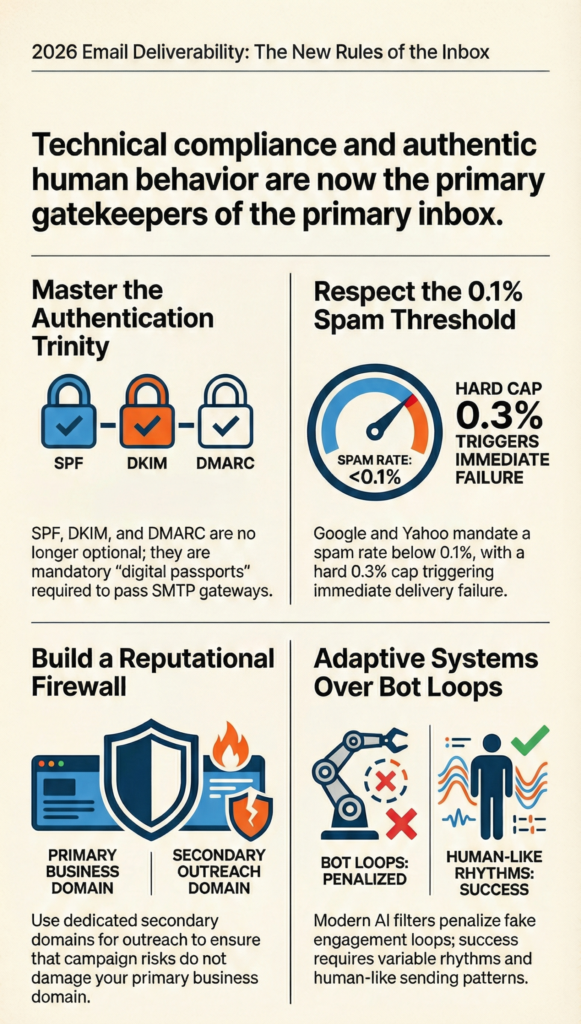
The “Authentication Trinity” (SPF, DKIM, and DMARC) is mandatory for bulk senders.
Failing to configure these correctly results in immediate penalties.
• SPF (Sender Policy Framework): This acts as a whitelist of IP addresses authorized to send mail for you. A critical challenge in 2026 is the 10-DNS-lookup limit. Modern tech stacks often exceed this, requiring “SPF flattening” tools to consolidate lookups and prevent delivery failures.
• DKIM (DomainKeys Identified Mail): This adds a digital signature to verify the email hasn’t been tampered with. The standard has evolved: 1024-bit keys are now considered insecure. You must use 2048-bit keys and rotate them regularly (every 90 days) to prevent replay attacks.
• DMARC (Domain-based Message Authentication, Reporting, and Conformance): This is the enforcer. A policy of p=none is no longer sufficient for cold outreach. Mailbox providers now expect a policy of p=quarantine or p=reject to prove you are a serious business entity and to protect your brand from impersonation.
3. Advanced Encryption: MTA-STS and DANE
Authentication proves who you are, but encryption protects how you send. The era of opportunistic encryption is gone.
• MTA-STS (Mail Transfer Agent Strict Transport Security): This protocol mandates that all incoming mail be delivered over an encrypted TLS connection. It prevents “downgrade attacks” where hackers try to force an unencrypted connection to intercept data.
• DANE (DNS-based Authentication of Named Entities): Leveraging DNSSEC, DANE binds certificates to domain names for robust assurance. Financial and government sectors increasingly require both MTA-STS and DANE for communication.
Implementing these protocols signals to providers like Google and Microsoft that your infrastructure is hardened and trustworthy, significantly boosting your cold email deliverability.
4. Infrastructure Strategy: The Reputational Firewall
Relying on a single primary domain for cold outreach is now considered a catastrophic risk. Best practices in 2026 dictate the creation of a “Reputational Firewall”.
Dedicated Subdomains: You should use dedicated subdomains (e.g., sales.company.com) or secondary domains for prospecting. This ensures that any reputational damage from outreach does not impact your primary domain used for internal and transactional communication.
The New Warm-Up Protocol: Warm-up tools have evolved because providers can now detect artificial “ping-pong” traffic. The 2026 protocol requires a 4–8 week gradual ramp-up:
• Weeks 1-2: Send 10-20 emails daily to highly engaged seed accounts.
• Weeks 3-4: Expand to 50 emails, introducing varied content.
• Weeks 5-8: Scale toward target volume, monitoring reputation dashboards daily.
5. Content and AI: Beating the Intent Filters
Mailbox providers now use advanced AI, such as Google’s RETVec, to analyze the “intent” and “style” of a message. They analyze the “Digital Fingerprint” of your sending behavior.
How to stop emails going to spam in this environment involves avoiding “Style Mimicry” flags. If a sender suddenly adopts an urgent, formal tone with a recipient they have never contacted, AI filters assign a high-risk score.
To succeed:
• Avoid Spam Triggers: Words like “guarantee,” “free,” or excessive capitalization are immediate red flags.
• Hyper-Personalization: Use intent data (hiring signals, news) to make the message relevant. Generic templates are easily identified by AI as automated spam.
• Plain Text: Prioritize plain text or minimal HTML (95/5 text-to-image ratio) to look like a human-to-human conversation.
6. The Compliance Gate: Spam Rates and Unsubscribes
Compliance is now a technical signal used to determine trustworthiness.
The 0.1% Rule: The spam complaint rate is the most critical metric. You must maintain a rate below 0.1%. If you hit 0.3%, you are ineligible for mitigation and face immediate filtering. This is a hard cap enforced by Google and Yahoo.
RFC 8058 (One-Click Unsubscribe): For bulk senders, a simple link in the footer is no longer enough. You must implement RFC 8058 headers:
• List-Unsubscribe-Post: List-Unsubscribe=One-Click
• List-Unsubscribe: <https://domain.com/unsubscribe>
This allows the email client (like Gmail) to show a native “Unsubscribe” button at the top of the email. If you fail to implement this, frustrated users will use the “Report Spam” button instead, destroying your reputation.
7. Visual Trust: Implementing BIMI
Brand Indicators for Message Identification (BIMI) allows you to display your verified logo next to your email in the inbox.
In 2026, this is a powerful psychological signal of trust.
To use BIMI, you must have DMARC enforced at p=quarantine or p=reject.
New updates, such as the lps= tag, allow brands to customize logos for different departments (e.g., support vs. sales), adding granular branding to your authenticated emails.
8. Managing Sending Limits
Even with perfect infrastructure, exceeding volume limits will hurt your cold email deliverability.
• Google Workspace: 2,000 messages/day.
• Microsoft 365: 10,000 messages/day.
• Zoho: Strict policies against cold outreach; often caps at 500/day.
To scale beyond these limits without triggering alarms, use Sender Rotation.
This involves distributing your campaign load across multiple inboxes and domains to maintain low per-inbox volume (e.g., 50 emails/day), mimicking natural human behavior.
Conclusion
The path to the inbox in 2026 is paved with technical rigor.
Success is no longer about volume; it is about identity, relevance, and compliance.
To master cold email deliverability and solve the problem of how to stop emails going to spam, you must:
1. Authenticate with SPF, DKIM, and enforced DMARC.
2. Encrypt with MTA-STS.
3. Isolate reputation using dedicated subdomains.
4. Comply with RFC 8058 one-click unsubscribes.
5. Personalize content to pass AI intent analysis.
In the reject-first era, the most effective “hack” is simply being a sender that looks, acts, and technically verifies as a legitimate professional.
Cold Email Isn’t Dead in 2026—It’s Just Grown Up
Introduction
Every year, the same headlines appear declaring that cold email is dead.
Critics argue that inboxes are overflowing, spam filters are impenetrable, and the tactic is “100% dead”.
But the data tells a different story.
The truth is that lazy cold email is dead.
In 2026, cold email remains one of the most powerful strategies for B2B growth—provided you stop “spraying and praying” and start treating it as a precision tool.
Here is why cold email is not only effective but essential in the current landscape.
1. It Is the Most Cost-Effective Channel
While paid marketing channels are becoming prohibitively expensive, cold email offers a significantly higher ROI.
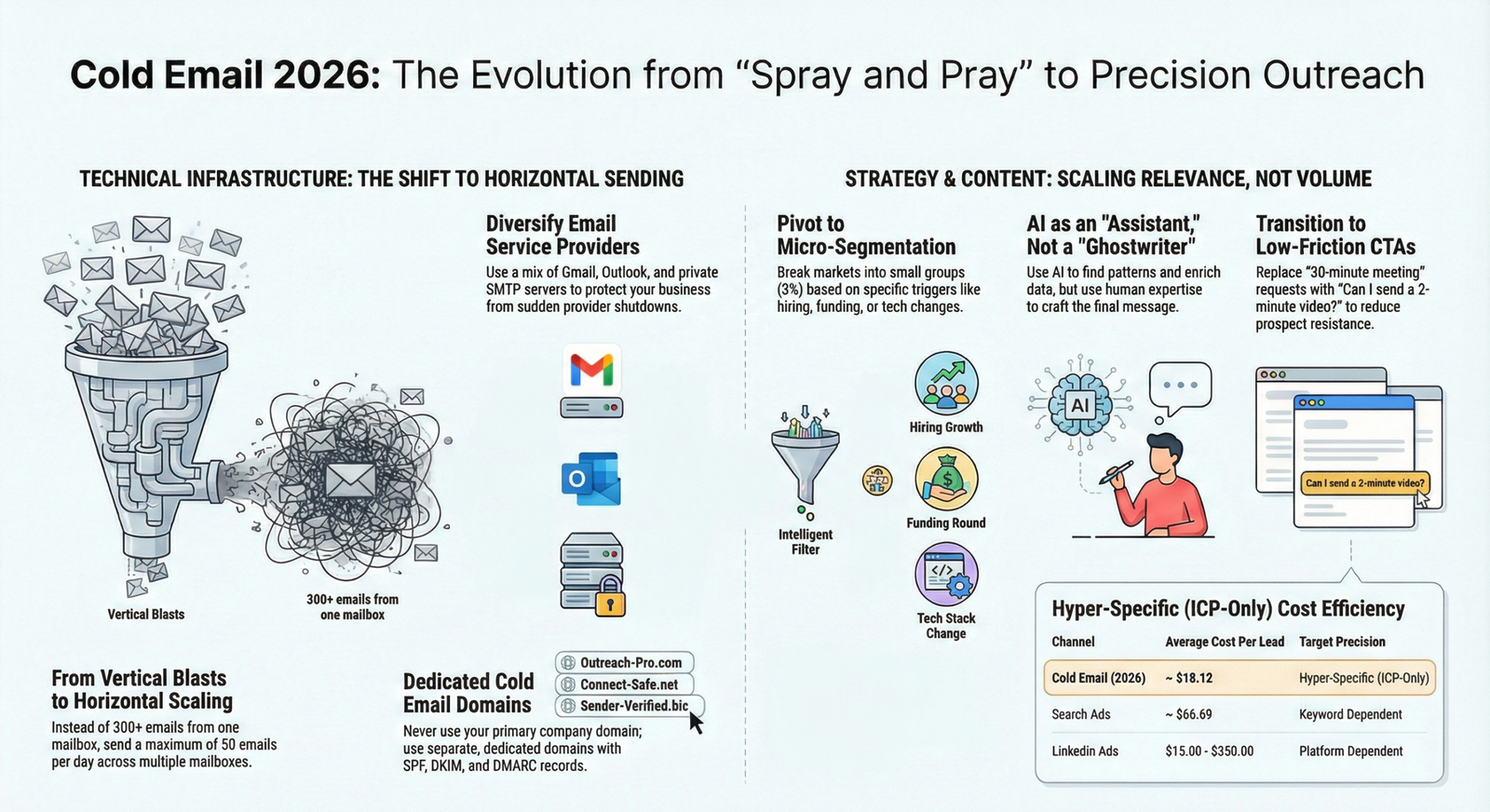
Recent benchmarks show that the cost per lead for LinkedIn ads can range from $15 to $350, whereas cold email can drive leads for as little as roughly $18.
Unlike ad auctions where costs rise with competition, cold email costs remain stable.
For a standard subscription, you can contact thousands of prospects, making it accessible even if your deal size starts as low as $1,000.
It is a simple, scalable way to reach target customers without paying a premium for every click.
2. Relevance Has Replaced Generic “Personalization”
The days of faking familiarity with a “Just touching base” or “I hope this finds you well” are over.
These generic templates are now ignored or filtered out.
In 2026, effectiveness comes from micro-segmentation.
Instead of blasting 10,000 contacts, successful senders focus on the “right 3%” of their market.
By using advanced data enrichment, you can build detailed segments based on specific triggers, such as a company hiring for a specific role, raising funding, or changing their tech stack.
When you target a prospect based on a business change rather than a demographic trait, your message transforms from an interruption into an interception.
You aren’t just selling; you are solving a timely problem.
3. It Is the Only Channel You Own
Social media algorithms change constantly, and gatekeepers can block phone calls, but email remains a direct line to a decision-maker.
It is a channel where you control the volume, the targeting, and the narrative.
Furthermore, cold email acts as a conversation engine. Even a “no” provides valuable first-party data that helps you refine your positioning and pricing in the real world.
4. The Infrastructure Has Evolved
A major reason people fail at cold email today is that they are using 2015 tactics in a 2026 environment. To succeed now, you must adopt horizontal sending.
Rather than sending hundreds of emails from one address, the new standard is to send low volumes.
Approximately 50 emails per day, across multiple mailboxes and domains.
This approach mimics human behavior and keeps your sender reputation high, ensuring you land in the primary inbox rather than the spam folder.
5. AI Is the Assistant, Not the Writer
While AI is prevalent, using it to write your entire script often results in robotic, disconnected copy.
The most effective deal-closers use AI for research and segmentation—finding patterns and clusters in data—while retaining a human touch for the actual messaging.
The goal is to balance scalability with a genuine, human voice.
How ProspectArc Can Power Your 2026 Strategy
If you are ready to implement a modern, high-precision cold email strategy, ProspectArc provides the all-in-one infrastructure you need to scale.
ProspectArc helps you move beyond the “spray and pray” method with features designed for 2026:
• Access 450M+ Verified Leads: Stop wasting time on bad data. Search a massive database of verified B2B contacts to find your perfect ICP.
• Smart Personalization: Utilize an AI-powered engine that customizes every email based on recipient data to significantly boost your reply rates.
• Automated Intelligence: Set up drip campaigns with intelligent follow-ups and optimize your send times automatically.
Don’t let outdated tools hold back your growth.
Start your free 14-day trial with ProspectArc today and turn cold outreach into warm conversations.